
Federal Releases Connected to Early County
Federal custody can begin after a local arrest, a federal warrant, or a federal court order. The Early County Jail could serve as a temporary hold, but research found no federal jail located in the county and no basis to treat the county jail as the final federal release point.
A sentenced federal prisoner falls under the Bureau of Prisons. A pretrial federal detainee is generally managed by the U.S. Marshals Service and may be housed in a contracted state, local, or private facility. Someone who leaves a local jail for federal pickup has transferred rather than entered the community.
After BOP release, a person may enter the community, a residential reentry setting, supervision, or another agency’s custody. The federal court judgment and BOP record provide context that an Early County jail entry cannot supply.
How to Confirm an Early County Federal Release
Start with custody type, not the arrest location.
- Search the BOP Inmate Locator by name or federal register number for a sentenced prisoner.
- Read the displayed release date and any “Released” or “Not in BOP Custody” wording.
- Do not assume “Not in BOP Custody” identifies where the person is now.
- For a pretrial detainee, identify the federal court case and contact the U.S. Marshals district detention channel.
- Check the federal docket for a release, detention, sentencing, or transfer order.
- If Early County held the person briefly, request the county transfer record to identify the receiving agency.
The BOP Inmate Locator is the correct public starting point for sentenced federal custody. A county roster or GDC offender search does not replace it.
BOP and U.S. Marshals Release Records
The BOP locator supplies a public status and release-date lead. For the legal basis of detention or release, use the federal court file. The U.S. Marshals Service manages federal prisoners from arrest through federal court proceedings and transports or houses detainees through its prisoner operations network.
Correct Federal Custodian
Sentenced federal prisoner: Federal Bureau of Prisons and its Inmate Locator.
Pretrial federal detainee: U.S. Marshals Service plus the federal court docket.
Temporary Early County hold: Early County Sheriff transfer or release record.
A federal release record is not requested from GDC unless the same person separately entered Georgia state custody. It is not requested from ICE unless immigration custody followed.
No Federal Jail in Early County Was Confirmed
This page represents federal detention channels serving a person connected to Early County, not a physical federal facility in Blakely. That distinction prevents a common error: calling the local jail for a long-term BOP prisoner or using BOP for someone who was only booked on a county charge.
If Early County staff says the person was released to another agency, ask for that agency’s name and the transfer time. “Federal hold” can be a lead, but the receiving record or federal case number is needed to identify whether BOP, the Marshals Service, or another federal authority controls the next step.
Reading BOP Release Status Correctly
A BOP result can show a release date and may use “Released” or “Not in BOP Custody.” Those phrases describe BOP custody. They do not establish that all charges are over, that supervised release has ended, or that another agency did not take custody.
| Locator result | Next check |
|---|---|
| Current BOP facility | Use BOP facility and case information. |
| Released with date | Confirm court terms and any supervision. |
| Not in BOP custody | Check Marshals and federal court records. |
| No match | Retry aliases or register number, then verify custody type. |
The locator’s date is especially useful for sentenced inmates, but an actual movement can be affected by court orders, transport, or another hold.
U.S. Marshals Pretrial Detention Path
The Marshals Service has responsibility for many federal detainees awaiting court action. Its public prisoner-operations material describes custody, transport, and detention functions, but it is not a county-style released-inmate list.
Use the federal court docket to find detention and release orders, then contact the Marshals office tied to the court district when current location or release routing needs confirmation. A person can be moved among contract facilities without becoming a BOP sentenced prisoner.
If a federal court orders release, read the conditions in the actual order. A transfer to BOP after sentencing moves the search to BOP. A transfer to ICE moves the custody check to the ICE locator.
Federal Release Versus County Release
An Early County jail record documents when local custody ended. It cannot, by itself, prove when federal custody ended. Conversely, a BOP release date does not explain an earlier Early County arrest, bond, or local disposition.
Build a custody timeline with the county booking and transfer, the federal court order, the Marshals detention stage, and the BOP result when applicable. This avoids counting a transfer as two releases or treating a local roster disappearance as freedom.
The Early County released-inmate guide covers the local release record. Use it only for the local segment of a federal case.
Official BOP Locator View
The official BOP source is matched to the successful federal manifest image below.
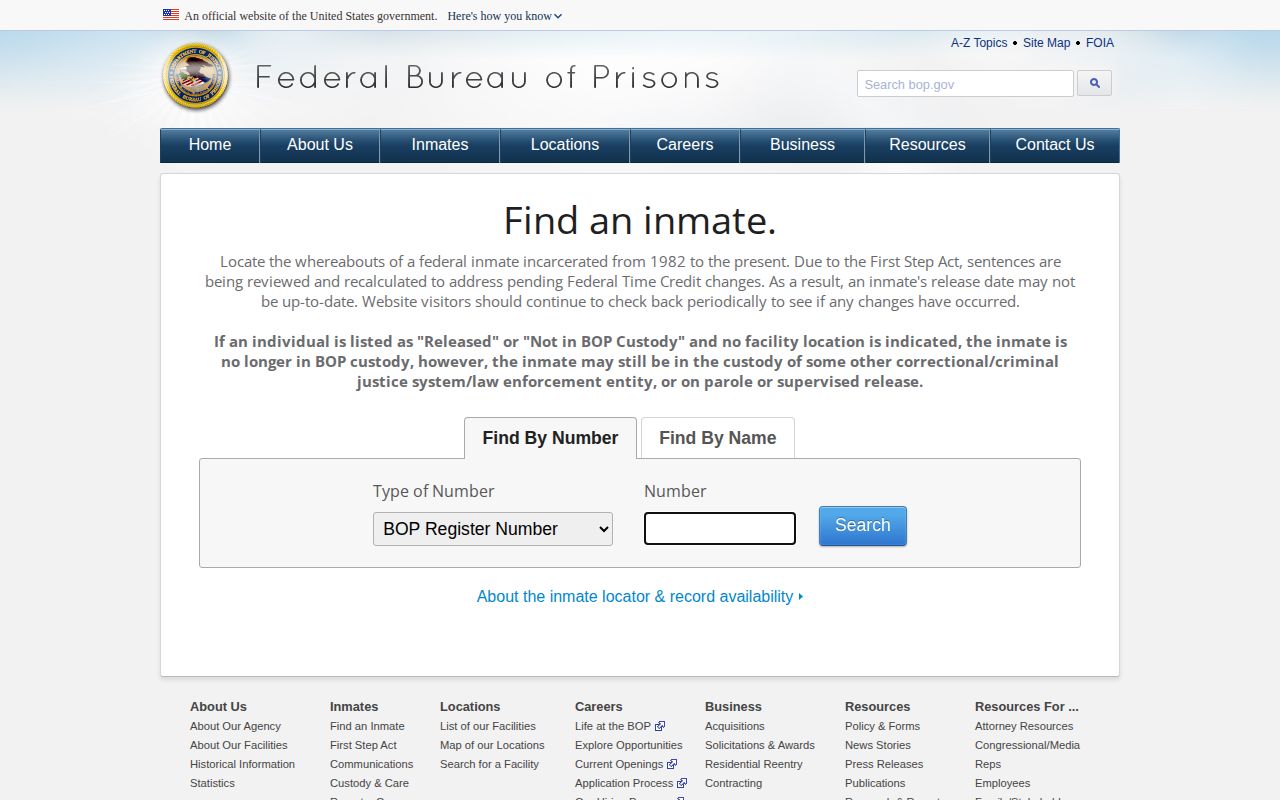
The image identifies the federal search front door; the result still needs the custody-type checks described above.
Keep Federal Identifiers With the Timeline
A federal register number, court case number, and known aliases can separate people with similar names. Preserve the source and check date with each status. This makes verification easier if the person moves between Marshals custody, BOP custody, supervision, or another agency.
When a result changes, record the wording rather than rewriting the earlier status. A custody timeline should show that each agency spoke only for its own period.
Federal Supervision After BOP Release
A BOP release date can mark the end of prison custody while federal supervised release remains. The federal judgment and probation office records, where available and releasable, describe that next stage. Do not use an Early County probation office or Georgia DCS to verify federal supervision unless a separate state case also exists.
A person can also leave BOP for another custodian. Read “released” as the end of the listed BOP custody, then check the court and any documented receiving agency before concluding that the person entered the community.