
Early County Releases Through the Georgia State Prison System
GDC is a statewide prison system, not a physical Early County jail. It becomes the relevant custodian when an Early County Superior Court sentence results in state prison. The person may first remain at Early County Jail while awaiting pickup, then depart the county facility under a release reason such as transfer to GDC.
That transfer closes the local jail stay but does not place the person in the community. The state sentence continues under GDC. Later outcomes may include parole, completion at the maximum release date, or another authorized discharge. The lasting proof comes from GDC, Board, DCS, and court records, each of which answers a different part of the release question.
How to Confirm an Early County GDC Release
Begin with the most exact identifier available. A GDC ID usually avoids mistaken identity better than a name-only search. If it is unknown, use the fields offered by the statewide offender query and compare all available descriptors.
- Open the GDC offender query.
- Search by GDC ID, or use first and last name with age, case number, and other identifying fields.
- Read the current facility or status. A facility listing indicates continued GDC custody, not release.
- Review the release date, maximum release date, and parole or pardon link where displayed.
- Check the Board's TPM lookup for a person still awaiting parole review, or the parolee search after parole release.
- Use DCS Donalsonville when the released person is assigned to felony community supervision serving Early County.
- Request the GDC record if the public fields are incomplete or unclear.
A released or discharged GDC status confirms departure from the state prison system reflected by that record. It does not by itself prove that every court obligation ended or that no supervision followed.
GDC Offender Search Fields for Early County Cases
Georgia's public guidance says adult offenders may be searched by name, ID or case number, age, and other identifying details. GDC's family guidance says the tool may show charges, facility location, and release date. The result may also lead to parole or pardon status.
| Field or link | How to read it |
|---|---|
| GDC ID | State identifier for matching the correct offender |
| Facility or status | Shows current prison placement or released/discharged status when available |
| Release date | State-prison release information, not the earlier county transfer date |
| Maximum Release Date | The sentence max-out date defined by GDC rules; not available for life or death sentences |
| Tentative Parole Month | A planned Board review month, not a guaranteed release day |
| Parole/Pardon status | Route to Board information that can clarify parole consideration or status |
The manifest image below is linked to the official GDC offender query.
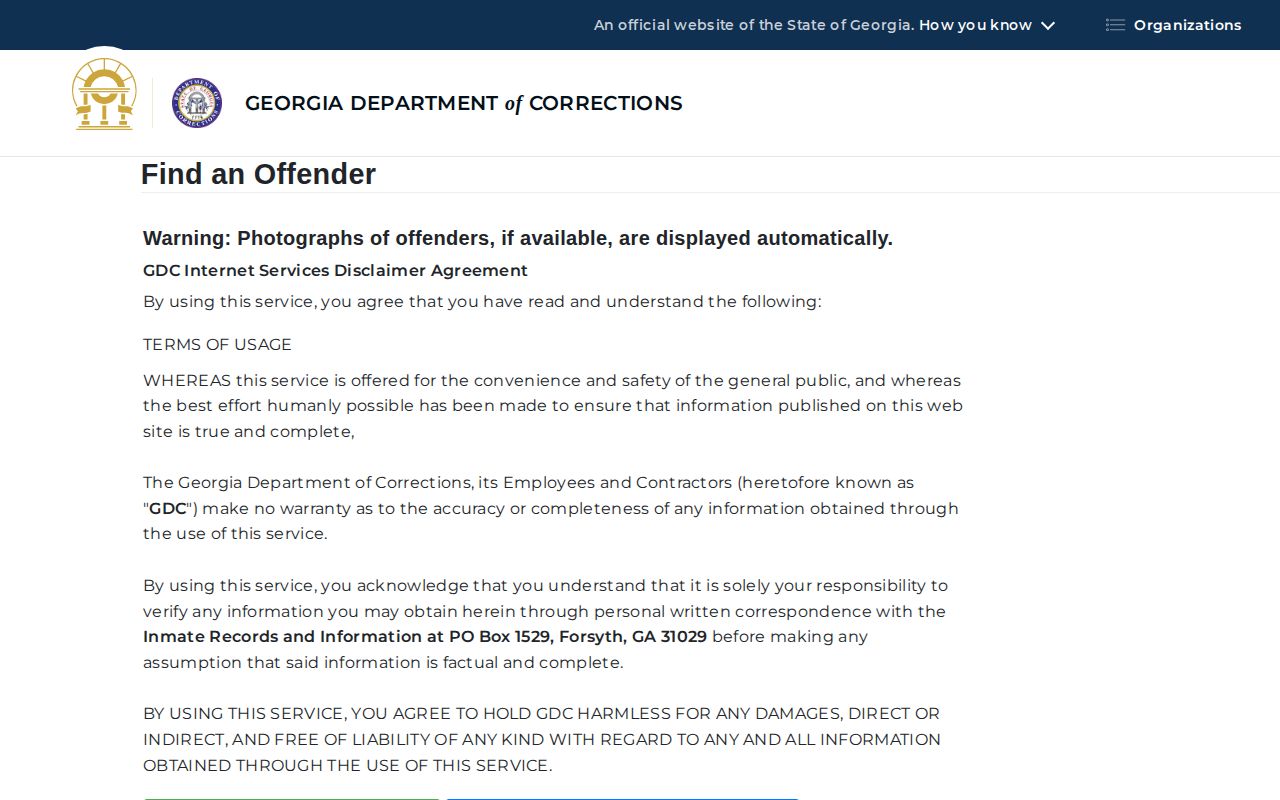
The search form is the statewide starting point for an Early County case that moved from the jail into state prison.
GDC Release Dates Are Not All the Same
Maximum Release Date, Tentative Parole Month, and actual release date describe different stages. Georgia rules define the maximum date as the point when the sentence maxes out and the person cannot be held longer on that sentence. Life and death sentences have no maximum release date under that definition.
A TPM is set by the State Board of Pardons and Paroles as a tentative year and month for parole planning and final review. The Board says it is not a final decision. Conduct, program requirements, sentence changes, legal eligibility, and Board action can affect the outcome. A parole release date, once set, may still be changed before the person leaves.
The actual GDC release record is therefore the best confirmation of departure. If parole follows, the Board's parolee search may show parole begin and end dates, primary offense, and parole office. DCS then supplies the field-supervision contact.
Georgia Credits and Mandatory Service
Eligible GDC offenders may have sentence length affected by approved incentive programs. The Performance Incentive Credit program links progress in education, vocational activity, treatment, work assignments, and conduct to an opportunity to reduce length of stay. Georgia rule 125-3-7 permits work incentive credit for institutional attainment, except for life-sentenced inmates.
Those programs do not create a universal release formula. O.C.G.A. 17-10-6.1 imposes mandatory-service rules for serious violent felonies, and O.C.G.A. 42-9-45 contains general parole eligibility with important exceptions. Sentence date, offense, recidivist treatment, life-sentence rules, Board policy, credits, and holds can all matter.
Parole Review After an Early County Prison Sentence
The State Board of Pardons and Paroles decides parole. Georgia's process is mainly file review, not an inmate appearance at a local Early County hearing. Public Board meeting notices are agency calendar events and should not be mistaken for a person's parole hearing date.
The TPM lookup applies before release when the Board has established a tentative month. The parolee search applies after parole begins. Results may include a parole office and dates, while a review may produce denial, reconsideration, final review, a release date, or no parole when the person is legally ineligible.
An Early County court record remains useful because it shows the conviction and sentence. It does not replace the Board decision or GDC sentence calculation. Once GDC has custody, Early County Jail staff do not control parole timing.
Early County Community Supervision After GDC
Georgia DCS handles felony parole and probation field supervision. The Donalsonville Field Office serves Early County from 223 S. Wiley Avenue, Donalsonville, GA 39845. Its listed phone is 229-524-2836 and its hours are Monday through Friday, 8:00 a.m. to 4:30 p.m.
This regional office is different from the Early County Sheriff's Office probation function located inside the county jail. The sheriff page says local probationers report there on the first and second Tuesday of each month. For a parolee released from GDC, or a felony probation case assigned to state supervision, use DCS Donalsonville and the Board or court record. Read the order rather than assuming which office applies.
Georgia DOC Records and Contact
GDC lists 300 Patrol Road, Forsyth, GA 31029 as its mailing address and 404-656-4661 for inmate concerns or questions. Open-records requests should go through the official GDC Open Records Request portal. This route is appropriate when the offender query does not show enough detail to establish the state release or discharge history.
Georgia Department of Corrections
300 Patrol Road
Forsyth, GA 31029
Inmate questions: 404-656-4661
GDC Open Records Request
Include the full name, GDC ID, date of birth if known, Early County as the sentencing county, and the exact fields requested. Useful fields include admission and facility history, maximum release date, actual release or discharge date, and parole status. A focused request is easier to route than a broad demand for every record.
Where a Person Goes After a GDC Release
A person may leave GDC into the community with no active prison custody, enter parole supervision, move to another authority under a detainer, or encounter a separate case. The offender result should be read with the Board, DCS, and court records when any of those outcomes is possible.
If the state record says released but family information suggests another hold, ask GDC for the release destination or transfer notation. A county jail roster is not the way to confirm a completed state-prison release. Likewise, a VINE alert is a custody-change lead, not the detailed discharge record.
For a complete search path that begins before the custody type is known, use the Early County released inmate records guide. It separates local jail release, GDC release, federal custody, immigration custody, and post-release supervision without treating one database as universal.
Released Versus Still in GDC Custody
A current facility means the person remains in the state system at the time reflected by the query. A released or discharged status points to the end of the GDC custody event, but details can lag or be incomplete. A maximum release date in the future is not a current release.
| Result | Next check |
|---|---|
| Current GDC facility | Review sentence fields and TPM; the person is not yet confirmed released |
| Released or discharged | Read the date, then check parolee search and DCS if supervision may follow |
| No result | Check identifiers, Early County Jail, court records, or another custody system |
| County transfer notation | Follow the receiving GDC record rather than treating the jail departure as freedom |
When public data conflicts, the record from the office that held custody carries the most direct explanation. GDC should confirm state-prison release; the Board should confirm parole action; DCS should confirm field supervision; and the Early County court should confirm the sentence.