
Early County Scheduled and Actual Release Dates
A scheduled or projected date is an estimate or sentence-computation field. An actual release date records when custody ended at a particular jail or prison. The two may differ because of court orders, credits, discipline, parole action, detainers, or transfer. Even an actual departure from Early County Jail may be a transfer to another agency rather than release into the community.
Pretrial custody works differently. A person awaiting trial may leave after bond, a modified bond, dismissal, warrant clearance, or another court order. None is a sentence-based date that can be calculated in advance from the jail website. Early County does not publish an official release-date calculator or a verified recent-release feed.
How to Find an Early County Inmate Release Date
The correct workflow follows the person rather than the arrest county alone. Early County Jail holds pretrial detainees, county-sentenced people, and some city or state inmates. A transfer out can shift control of the date to GDC or another agency.
- Confirm the current custodian. Call Early County Jail at 229-723-3150 for a local booking, or search GDC if a state-prison transfer is possible.
- For a local case, obtain the sentencing document, bond order, or other release order from the Early County court record.
- Ask the jail for the expected local date and all active holds. If a copy is needed, request booking and release information through the sheriff's open-records channel at 229-723-3577.
- For a GDC case, search by GDC ID when known, then review facility, status, maximum release date, release date, and any parole link.
- Use the Board's TPM lookup when the record points to parole consideration. Use the parolee search after release on parole.
- Confirm the event with the jail, GDC, Board, or DCS. A VINE alert is useful notice, but it is not the full release record.
The Early County released inmate guide provides the broader records path when the last custodian is uncertain.
Early County Jail Dates Depend on Court Action
The sheriff detention page says Early County Jail houses pretrial inmates, post-trial inmates serving local sentences, and city and state inmates. It does not state a local good-time formula. No county rule should be inferred from a different Georgia jail.
For a pretrial detainee, check the Early County Clerk record for a bond order, first appearance, dismissal, or disposition. The clerk manages Superior, State, and Juvenile courts at 111 Court Square, Suite C in Blakely. A court order may authorize release, but jail staff must still clear warrants, detainers, and administrative steps before the person leaves.
For a short local sentence, ask for the sentence-start date, credited time, computed completion date, and any hold. The sheriff release record should later show the actual date, time, and reason. A record marked “transfer” means the local stay ended, not that all custody ended.
GDC Fields for an Early County State Sentence
When an Early County Superior Court sentence sends a person to state prison, GDC becomes the sentence custodian. The GDC offender query accepts an ID or identifying search fields. Georgia sources describe searches by name, ID or case number, age, and other identifying details.
| Field | What it means |
|---|---|
| Current facility or status | Whether GDC still lists the person in custody or shows a released or discharged status |
| Maximum Release Date | The date the served sentence reaches its maximum; none exists for life or death sentences |
| Tentative Parole Month | The planned month for final Board review, not a promised release day |
| Release date | A date associated with departure from GDC custody when displayed |
| Parole/Pardon status | A link or path to Board information that may clarify parole consideration or release |
The image below comes from the official Inmate TPM Lookup explanation.
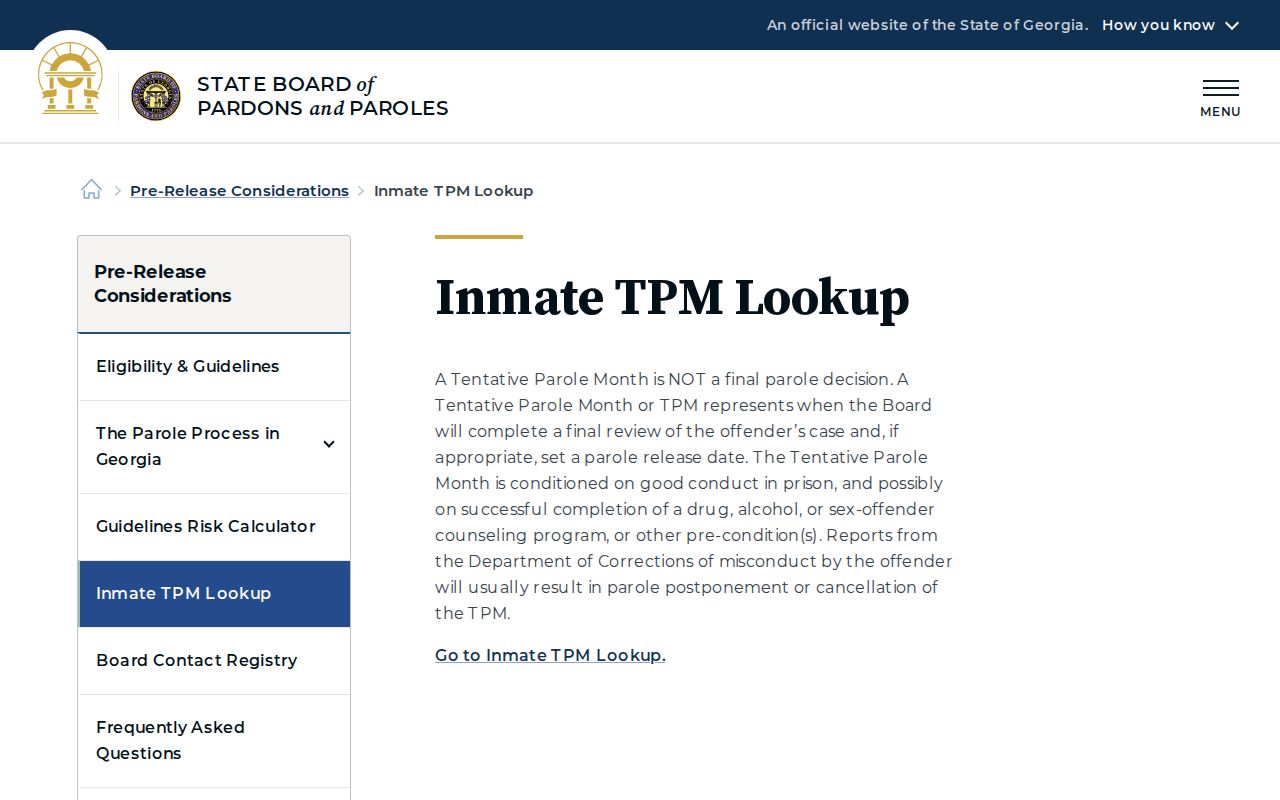
That source explains why a tentative month must be separated from a final parole release date.
Georgia Maximum Release Date and TPM Are Different
Georgia administrative rules define Maximum Release Date as the point when the inmate maxes out and cannot be held longer on the sentence being served. Life and death sentences have no such date. The same rule defines Tentative Parole Month as the planned year and month for parole placement as determined by the Board, generally excluding life or death sentences and sentences of twelve months or less.
The Board says a TPM is when it expects to complete final review and decide whether to set a parole release date. Good conduct or required program completion may be conditions. The Board may deny parole, choose reconsideration, change the tentative result, or later set a release date. Therefore, a TPM earlier than the maximum date is not a contradiction. The fields answer different questions.
Credits That May Affect a Georgia Release Date
GDC's Performance Incentive Credit program offers eligible people a chance to reduce length of stay through satisfactory progress in education, vocational work, treatment, work assignments, and good behavior. It is an eligibility-based state program, not an automatic county-jail credit.
Georgia administrative rule 125-3-7 also authorizes work incentive credits for institutional achievement in work, education, vocational, and related areas, except for life-sentenced inmates. Whether a particular person qualifies, how much is applied, and whether it remains earned must come from the sentence computation record.
The image is linked to the official GDC Performance Incentive Credit page.
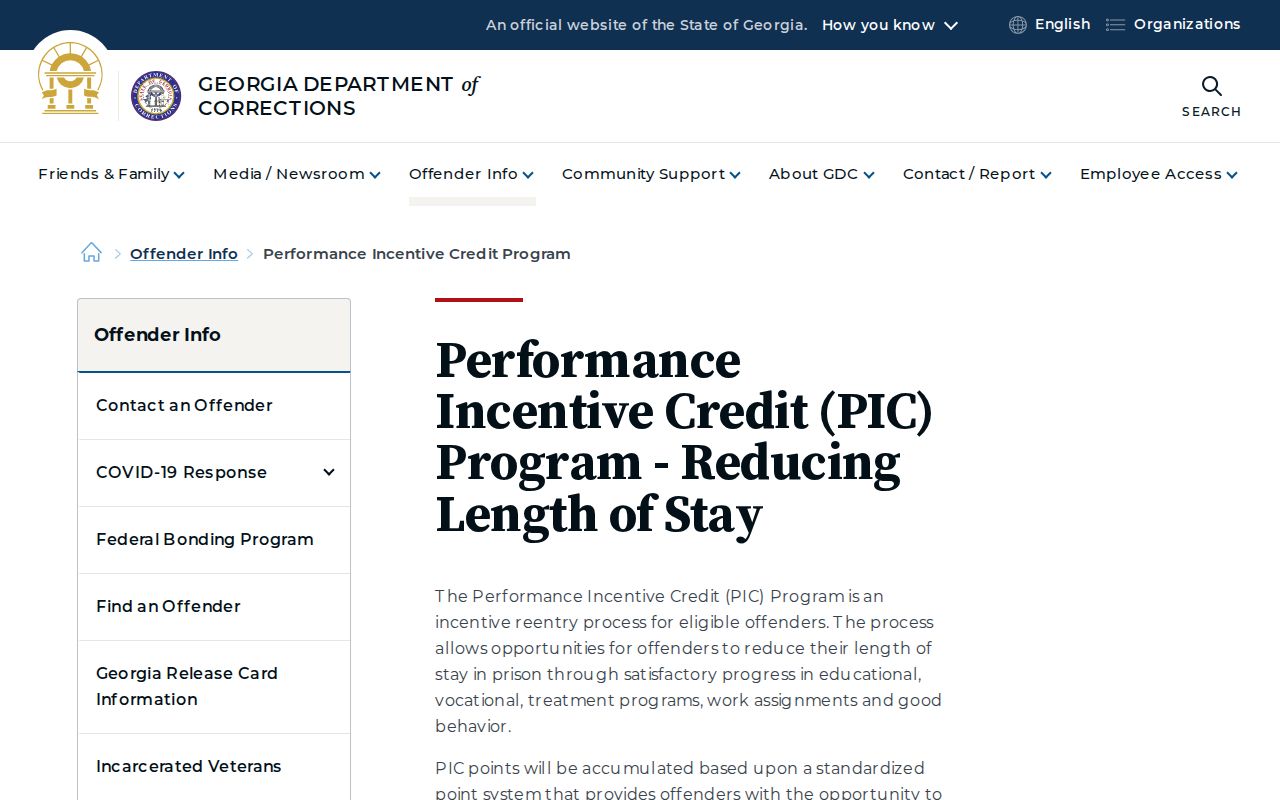
It identifies program progress and conduct as possible sentence-length factors for eligible GDC offenders.
Georgia Has No Universal 85 Percent Rule
Release-date questions are often reduced to a percentage, but the Early County calculation must use Georgia law and the person's actual sentence. O.C.G.A. 17-10-6.1 governs serious violent felony sentences. For covered non-life terms, it can require the sentence to be served in full without reduction by parole, early release, earned time, work release, leave, or similar measures, subject to limited transitional provisions. Covered life sentences have separate minimum-service rules.
General parole eligibility appears in O.C.G.A. 42-9-45, with exceptions for serious violent felonies, recidivist cases, life sentences, and other categories. The offense, conviction date, sentence language, parole eligibility, and other laws all matter. A generic percentage is not a reliable substitute for GDC computation and Board review.
The successful manifest capture is linked to Georgia's serious violent offender statute.
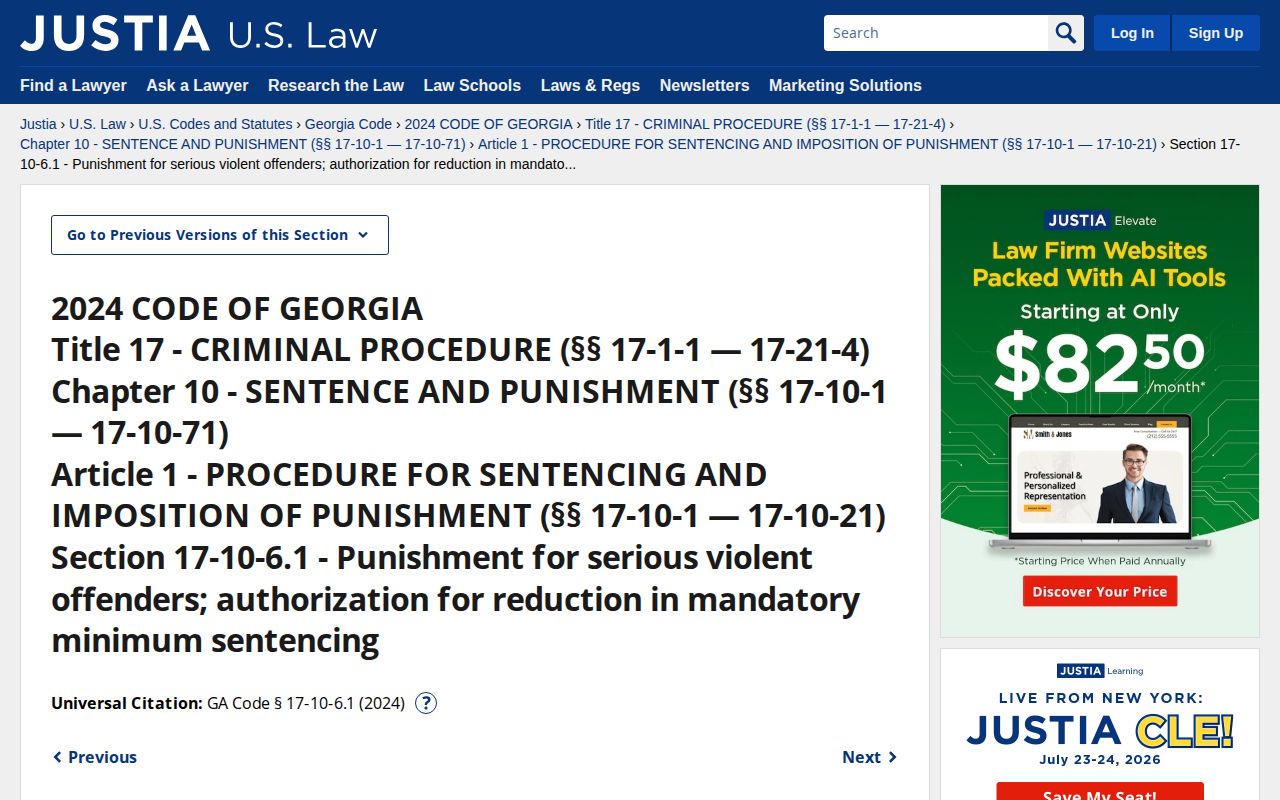
The statute illustrates why offense-specific mandatory service can override a broad release estimate.
Why an Early County Release Date Changes
A projected field can move before release. Ask which authority changed it and request the updated computation or order rather than relying on an old screenshot.
| Factor | Possible effect | Best source |
|---|---|---|
| Program or work credit | May shorten an eligible GDC stay | GDC sentence record |
| Disciplinary action | May remove credit or affect parole review | GDC and Board |
| Amended sentence | Changes the legal term or credited time | Early County court and GDC |
| Detainer or hold | May prevent community release or cause transfer | Jail, GDC, or receiving agency |
| Parole action | May set, deny, reconsider, or rescind a parole date | State Board of Pardons and Paroles |
| Calculation correction | Moves a date after record review | Custodian's sentence-computation unit |
A court order and an operational release are also separated by processing time. Identity checks, property return, transport, and hold clearance can make the actual event later than the legal authorization.
Transfers Are Not Early County Community Releases
Early County Jail can release a person to GDC, another county, federal authorities, or immigration custody. That transaction closes the local jail stay but does not place the person in the community. Ask for the release reason and receiving agency.
If the receiving agency is GDC, move to the offender query and Board tools. If federal custody is indicated, use the BOP Inmate Locator for a sentenced federal prisoner or federal court and U.S. Marshals channels for a pretrial matter. If immigration custody is indicated, the ICE locator is a current-custody check. An absent locator result is not conclusive because data and name formats can lag.
Confirming the Actual Early County Release
On the expected date, check the custodian again. For Early County Jail, ask whether the person is still held and whether the outcome was bond, sentence served, court order, or transfer. For GDC, read the updated status and release field, then check the parolee search and DCS Donalsonville if supervision follows.
Georgia VINE may send custody-change notice for a matching, participating record. It should be treated as an alert rather than the legal explanation. The VINELink Release Check gives the one-person search and registration steps. Preserve any alert, then obtain the sheriff, GDC, Board, DCS, or court record that explains the event.
If a record still conflicts, submit a focused request with the person's full name, identifying details, booking or GDC number, sentence county, and the exact date fields sought. GDC open records go through its official portal. Early County sheriff records questions go through the local open-records contact. Precise wording reduces the chance of receiving a current-custody answer when the question concerns a past release.