
ICE Transfers After Early County Release
A county jail may record the end of its own custody as a release even when another agency immediately takes the person. The release reason or receiving-agency field is therefore essential. If it says transfer, hold, detainer, or immigration pickup, continue the search instead of reporting a community release.
The Early County Sheriff record can establish the local release time and receiving agency. ICE controls the immigration detention record. A court docket may explain the local charge, but it does not replace the immigration custody check.
No confirmed ICE detention contract at Early County Jail was found. This page is a fallback path for an immigration transfer, not a claim that ICE operates a Blakely facility.
How to Check ICE Custody from Early County
The official locator accepts two search routes, and exact identity data matters.
- Ask Early County Jail whether the person left for another agency.
- Record the local release time, reason, and receiving agency.
- Open the ICE Online Detainee Locator System.
- Search by A-number and country of birth when the A-number is known.
- Otherwise search by full name, country of birth, and date of birth.
- If there is no result, check spelling and identity data, then contact the appropriate ICE office or detention facility.
The official ICE locator checks people entered into ICE custody systems. It is not an Early County inmate roster and does not archive every local release.
ICE and Early County Record Custodians
Request the county segment from Early County Sheriff’s Office. Ask for the release date and time, release reason, hold information where releasable, and the agency that accepted custody. Call the jail at 229-723-3150 for current local status or the open-records contact at 229-723-3577 for record-copy guidance.
Which Office Holds Which Record?
Early County Sheriff: local booking, local release, and transfer-out record.
ICE: immigration detention and ICE custody status.
Immigration court: hearing and proceeding records, not jail release records.
GDC or BOP: separate state or federal criminal custody.
One person may have records in several systems. Keep the times and agency names in sequence.
No ICE Facility in Early County Was Confirmed
The Facility Map describes an immigration custody fallback, not a local building. ICE may hold a person elsewhere after a Georgia jail transfer. The locator result, receiving-facility confirmation, or ICE record is the proper proof of that stage.
Do not infer immigration status from a name, birthplace, language, or county booking. Use the ICE route only when the sheriff record, an agency notice, a case record, or the person’s known information gives a factual basis for the check.
Search the ICE Locator Accurately
An A-number search requires the number and country of birth. A name search requires name, country of birth, and birth date. Enter names as accurately as possible, including spacing and order. A missing result can reflect spelling, recent processing, a record outside locator coverage, or release.
| Result | What to do |
|---|---|
| ICE facility shown | Confirm with the facility or ICE channel. |
| No match | Retry identity data and contact ICE if a transfer is documented. |
| County says transferred | Request the receiving-agency entry. |
| County says community release | Use the local record unless another factual hold appears. |
USA.gov provides plain-language instructions for locating a person detained by ICE. Its guidance supports the same two search routes and helps distinguish the locator from general court records.
When an Early County Release Is Not Freedom
A local jail can finish its legal authority over a person and release that person directly to another custodian. The county timestamp remains accurate, but the word “release” describes only the county’s control. This is why the receiving-agency field matters more than an absent roster name.
The same rule applies to a GDC pickup, another county warrant, a U.S. Marshals transfer, or ICE custody. Follow the agency chain until a record shows community release or the currently responsible custodian.
Georgia VINE may help with the county custody change, but it is not the ICE locator. The Early County release-record search path explains how to request the sheriff segment.
ICE Release and Immigration Proceedings
Leaving ICE detention does not necessarily end an immigration case. Release conditions, reporting requirements, or an ongoing proceeding can remain. The locator answers custody, while the immigration court or legal record answers case status.
Likewise, an Early County criminal case can remain open after bond even if no immigration custody exists. Keep the county court case, immigration proceeding, and detention status separate. This prevents a custody result from being misread as a legal outcome.
For current legal advice or interpretation of an order, consult a qualified attorney. Public locator results are status leads, not legal advice.
Official ICE Locator Guidance
The successful manifest capture comes from USA.gov’s official ICE locator instructions.
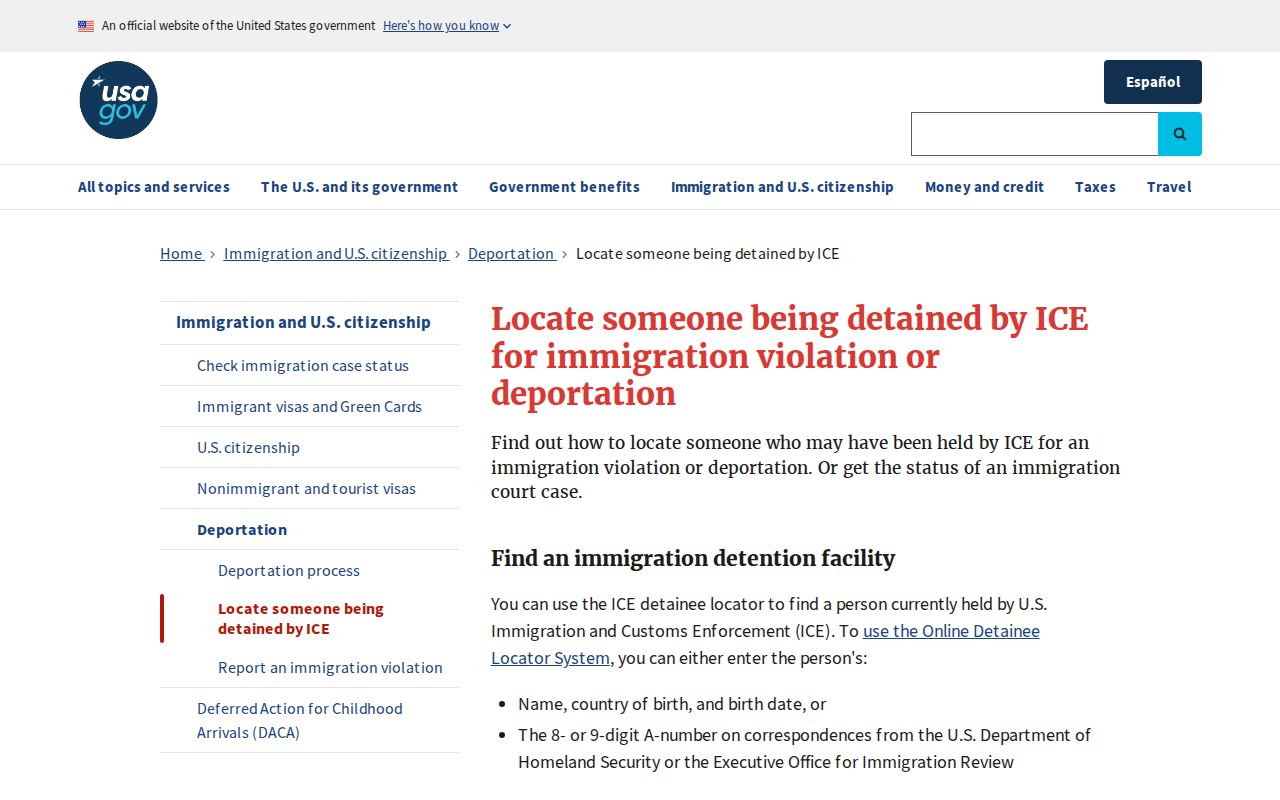
The image documents the federal guidance source; use the ICE locator and agency records for the individual custody check.
Document the Early County to ICE Timeline
Record the local booking number, release time, stated reason, receiving agency, and any A-number known from a legitimate source. Then note the time and exact wording of the locator check. This prevents a later ICE status from being mistaken for the time Early County custody ended.
If sources conflict, ask each custodian to address only its segment. The sheriff cannot certify a later ICE release, and ICE does not own the county booking. A court file may explain proceedings, but custody confirmation comes from the responsible agency.
What an ICE Locator Check Cannot Prove
The locator is a custody-finding tool, not a complete immigration case file. It does not turn an absent result into proof of community release, and it does not explain every court date, release condition, appeal, or reporting duty. Confirm detention with ICE and proceedings with the proper court source.
It also cannot certify the earlier Early County event. Obtain the local release or transfer record from the sheriff. Keeping those sources separate protects the timeline from a common mistake in which one database is asked to speak for another agency.
After ICE Custody Ends
A person may leave detention while an immigration proceeding continues. Release conditions or reporting can remain. The legal case should be checked through its official channel, while the custody end should be confirmed through ICE records.
If an Early County criminal case is also open, the county court record remains separate. A local bond or dismissal does not decide immigration custody, just as an ICE release does not decide the county charge.