
What Georgia VINE Covers for Early County
Georgia VINE is the statewide custody and case-notification layer. Coverage depends on the participating agency, its feed, and the kind of record. It is not a substitute for an Early County Jail release record and does not guarantee that every local booking will appear.
A result may identify a holding agency, facility, offender record, and current reported custody status. A notice can flag release, transfer, or another change. County jail, state corrections, federal, and ICE systems remain distinct, so first identify which agency actually had the person.
How to Check an Early County Inmate
Use identifiers carefully because a common name may return more than one record.
- Open Georgia VINE and confirm Georgia is selected.
- Search by offender name or ID.
- Compare matches using every identifier the result provides.
- Open the record and read the status plus agency or facility.
- If no result appears, retry spelling and aliases, then use the jail or GDC route.
- Treat the result as a lead and confirm it with the record custodian.
A released person often no longer appears on a live jail roster. The lasting proof is the sheriff release record, court disposition, or a GDC released/discharged record, depending on who held the person.
What an Early County VINE Result Shows
The available fields vary with the contributing agency.
| Field | Meaning |
|---|---|
| Name or offender ID | Helps match the correct person. |
| Custody status | Reports the source agency’s current status. |
| Agency or facility | Shows which custodian supplied the record. |
| Status change | May indicate release, transfer, or another event. |
| Notification options | Shows available phone, email, text, or app channels. |
“Released” means no longer in the listed custody. It does not prove that the court case ended, supervision ended, every hold cleared, or the person entered the community.
Register for an Early County Release Alert
Registration is tied to the selected record, so confirm the match before providing contact details.
- Select “notify me” or the equivalent status-change control.
- Choose the offered phone, email, text, or app method.
- Enter and confirm the contact information.
- Create the requested PIN for phone notices.
- Save the registration confirmation.
- Update or cancel the alert when the custody matter ends.
The PIN lets a recipient confirm receipt and manage repeat calls. An alert is timely notice, not a certified release record.
Confirm an Early County VINE Release
Call Early County Jail at 229-723-3150 for local custody. Ask whether the event was community release, bond, time served, transfer, or another agency pickup. For a written timestamp and reason, contact sheriff open records at 229-723-3577. If the person entered state prison, use the GDC offender query and then the Parole Board or DCS when supervision applies.
The Early County release-record guide explains how the jail, court, and GDC sources fit together.
Georgia’s Statewide Notification Shift
The Georgia Criminal Justice Coordinating Council and the Criminal Justice Coordinating Council Data Exchange Board announced the statewide automated victim-notification system using VINE Appriss on March 11, 2024. That change makes Georgia VINE a statewide front door rather than a county-only notification page.
For Early County, the distinction is useful because no verified official 24-hour or 72-hour public release feed was found. VINE can supply an alert layer, but a copy of the release record still comes from the sheriff, court, or GDC. The CJCC announcement documents the statewide deployment.
The successful manifest image from that official announcement shows the state source used for this notification context.
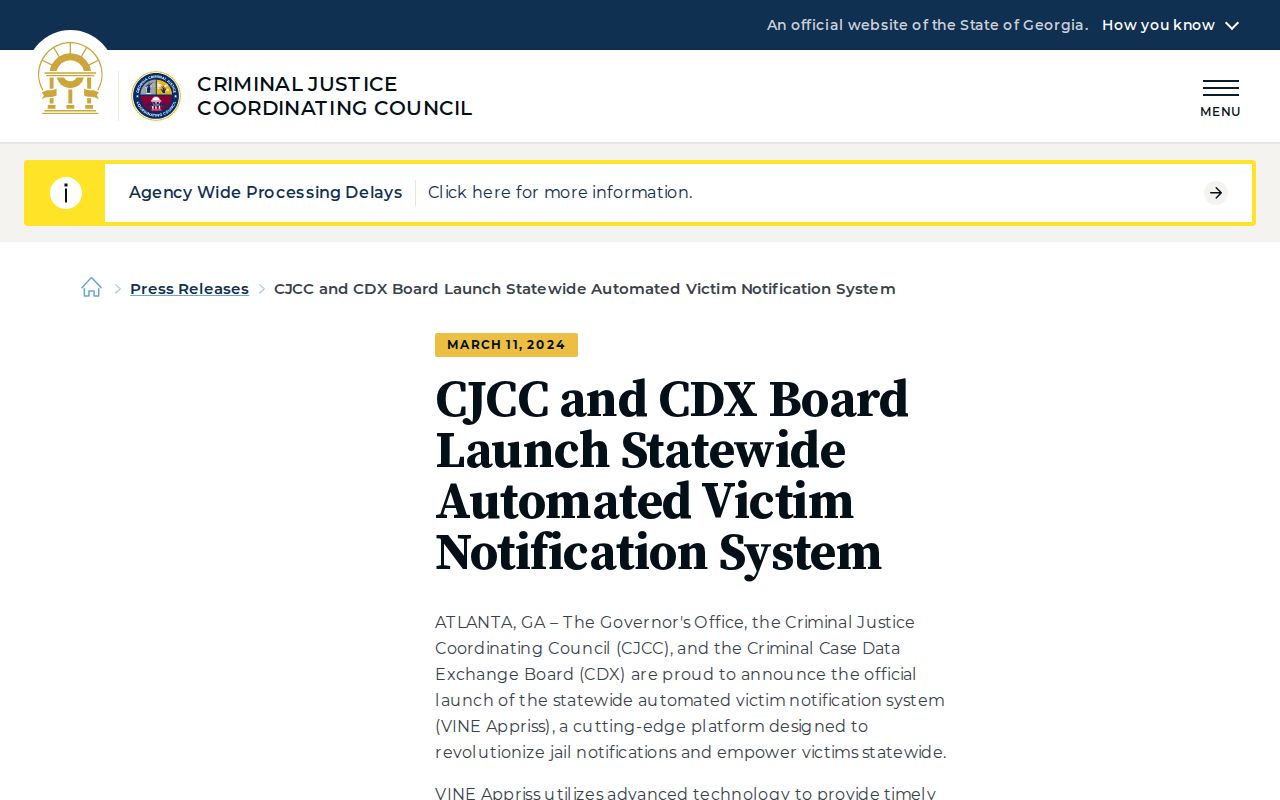
Use the state announcement for system context and the individual VINE record for the actual status check.
When Early County VINE Shows No Result
First check spelling, aliases, and date of birth. Then decide whether custody was local, state, federal, or immigration. Call Early County Jail for a local booking and search GDC for a state-sentenced person. BOP and ICE custody require separate federal locators.
A missing result can reflect coverage, timing, identity data, or the wrong system. It is not proof of release. If the sheriff confirms the person left, request the timestamp and reason. Follow a transfer to the receiving agency and compare bond or court-order releases with the docket.
Early County Release Alerts and Safety Planning
Keep the registration confirmation, choose a contact method that can be monitored, and use the phone PIN as instructed. A recipient should not rely on one automated message when current confirmation matters.
After an alert, contact the named agency. Ask whether the change was release, transfer, escape, or another event, and whether the timestamp is final. Do not contact or confront the person based on a result. Use emergency or victim-assistance channels for urgent safety concerns.
County, State, and Federal VINE Boundaries
Early County Jail creates the local custody record. GDC controls state-prison custody, while the Parole Board and DCS cover parole and supervision. Georgia VINE can supplement those sources when a participating feed supplies an event.
VINE does not establish the end of probation or parole. It also does not replace BOP, U.S. Marshals, or ICE systems. Identify the custodian, read the status, and confirm with the office that owns it.
Compare an Early County VINE Alert With the Jail Record
Write down the offender name, source agency, reported status, and time the notice arrived. Then call the jail and ask for the underlying event time. Notification delivery and release processing are not the same timestamp. If staff confirms the person is no longer held, ask whether the reason was bond, court order, time served, dismissal, transfer, or another hold.
For a lasting copy, submit a focused sheriff request with the full name, date of birth if known, booking date, and case or booking number. Ask for release date, release time, reason, and receiving agency. This process turns an alert into a documented custody timeline without asking VINE to certify a record it did not create.
Use GDC After an Early County Transfer
A person sentenced to Georgia state prison may leave Early County Jail by transfer. Georgia VINE can report a custody change, but the GDC offender query is the main state corrections record. Search by GDC ID when available or by name and compare age and other identifiers.
GDC may display facility, charges, release date, maximum release date, status, and a photograph when available. A parole link can lead to the statewide Board systems. A state-prison release should then be checked through the parolee search and DCS if community supervision applies. None of these state sources is a substitute for the county record when the person’s custody remained entirely local.
Understand Release, Transfer, and Supervision Alerts
A release notice says the listed custodian reported the person out of that custody. A transfer notice points to another location or agency. Neither result alone resolves an active court case, warrant in another jurisdiction, parole condition, probation term, or immigration hold.
For Early County bond cases, check the clerk’s court record after the jail status changes. For GDC releases, check Parole Board and DCS sources. For federal custody, use BOP or the Marshals route. This channel-by-channel review prevents a broad conclusion from a narrow automated event.
Keep an Early County Notification Log
Record the date of registration, selected person, agency, contact method, and confirmation number. When a message arrives, note its delivery time and exact custody wording before checking the official record. This small log helps distinguish a delayed alert from the underlying release time and preserves the chain when more than one transfer occurs.
Update the registration if the contact number or email changes. Cancel alerts tied to the wrong match or a custody matter that has ended. Never share a notification PIN publicly. If two records look alike, return to the identifiers rather than guessing from the charge or facility alone.
For a court or records issue, save the sheriff, clerk, GDC, or federal document that confirms the event. The automated notice can support the timeline, while the originating document supplies the durable proof.