
Early County Parole and Probation Compared
Parole and probation can both place a released Early County person under rules in the community, but they begin in different ways. The State Board of Pardons and Paroles decides whether an eligible GDC prisoner will be paroled. Georgia DCS then handles felony field supervision. Probation is imposed by a court, often without a state-prison release, or as the community portion of a split sentence.
| Point | Parole | Probation |
|---|---|---|
| How it begins | Board release from a GDC sentence | Court sentence or order |
| Main proof | Parolee search and Board record | Court sentence and DCS or local office record |
| Early County office | DCS Donalsonville for felony field supervision | DCS Donalsonville for felony cases; sheriff office for its published local reporting function |
| How it ends | Expiration, discharge, or other Board action | Court completion or discharge under the governing sentence |
How to Verify Early County Post-Release Supervision
Start with the custody history. A person who only bonded out of Early County Jail is not automatically on parole or probation. A person transferred from the jail to GDC may later appear in statewide parole records. A person sentenced directly to probation will usually be traced through the Early County court case and the agency named in that order.
- Check the Early County sentence or disposition to learn whether the court ordered probation, a split sentence, or prison.
- Search the Georgia parolee search for a person believed to be on parole. Review the parole begin and end dates, office, and primary offense when shown.
- For a person still in prison, use the TPM lookup. A tentative parole month is planning information, not proof of release.
- Use DCS Donalsonville to confirm which field office serves an Early County felony supervision case.
- For local probation reporting published by the sheriff, contact the probation office inside Early County Jail and compare its information with the court order.
A missing search result does not prove that supervision ended. Names may differ, the case may be probation rather than parole, or the record may require direct agency confirmation. The Early County released inmate search guidance explains how to trace the custody event before choosing the supervision route.
Early County Felony Supervision Runs Through Donalsonville
The state field office serving Early County is outside the county. The Georgia Department of Community Supervision lists its Donalsonville Field Office at 223 S. Wiley Avenue, Donalsonville, GA 39845. It serves Early, Clay, Miller, Quitman, Randolph, Seminole, and Terrell counties, along with the Pataula Circuit. Published hours are Monday through Friday, 8:00 a.m. to 4:30 p.m., and the phone is 229-524-2836.
DCS Donalsonville Field Office
223 S. Wiley Avenue
Donalsonville, GA 39845
229-524-2836
Monday-Friday, 8:00 a.m.-4:30 p.m.
This regional assignment is important when a GDC release record shows community supervision but no office in Blakely. DCS supervises felony probationers and parolees; it does not replace the Board's authority to decide parole or the sentencing court's authority over a probation judgment.
The manifest image below comes from the official DCS Donalsonville location page.
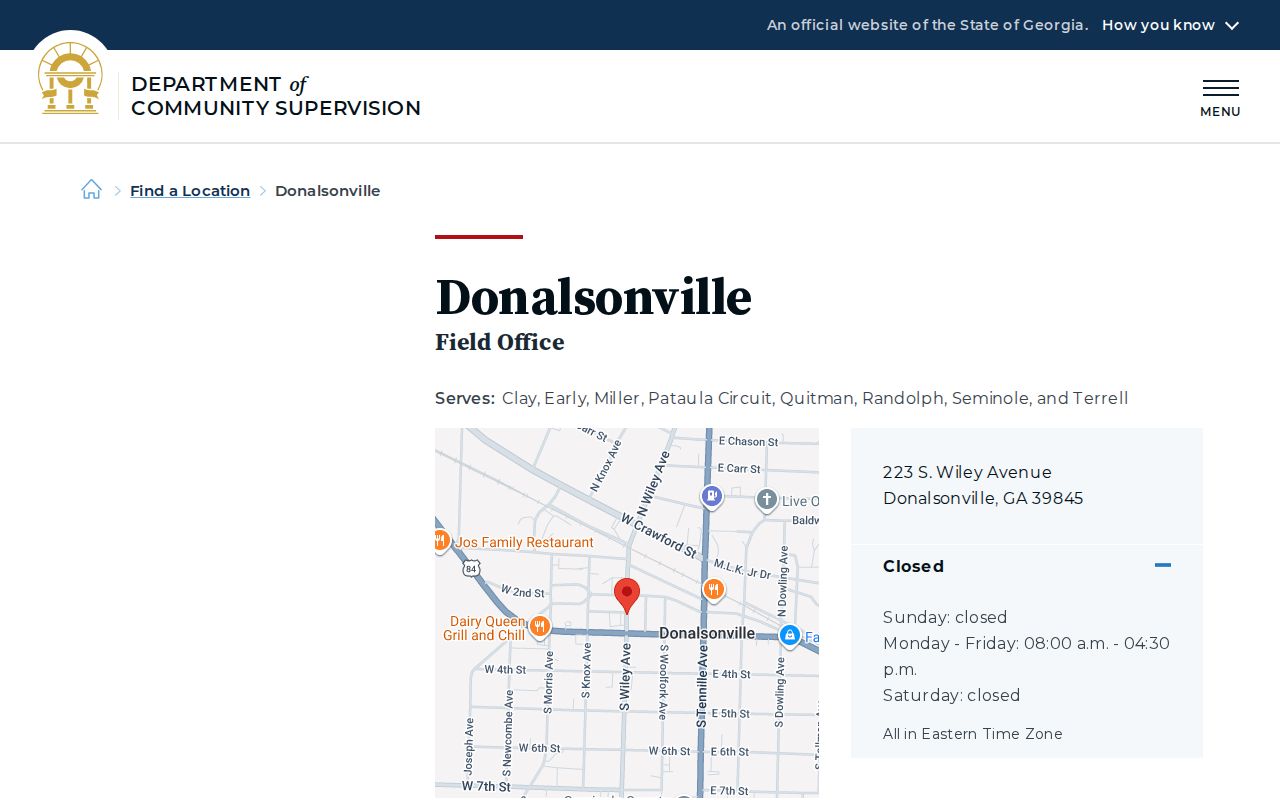
That office listing is the direct geographic link between Early County and statewide felony field supervision.
Local Early County Probation Reporting Is Separate
The Early County Sheriff's Office publishes a probation function inside Early County Jail at 18610 East South Boulevard in Blakely. Its page says probationers report on the first and second Tuesday of each month and gives 229-723-3579 extension 236 for questions. This is a local reporting path, not a substitute for DCS felony supervision.
To decide which office applies, read the probation order. The order should identify the court, term, conditions, and supervising authority. If the case is a felony probation, split sentence, parole, or reprieve handled by DCS, the Donalsonville office is the better starting point. If the person was told to report to the sheriff office at the jail, confirm that direction there and keep the court order available.
Georgia Parole Review Is Not a Local Hearing
Georgia parole is mainly a file-review process. People searching for an Early County parole hearing are often seeking a tentative parole month, a Board decision, a reconsideration date, or a public Board meeting notice. The Board's public meetings are not courtroom-style hearings where an incarcerated person appears to argue an individual case.
The Board's parole process explains review and final decision stages. A review may produce a tentative parole month, denial, reconsideration, a final review, or a parole release date. The Board may change or rescind a tentative result before release. Life sentences and legally restricted offenses follow distinct rules.
The image below is linked to the official Georgia parole process source.
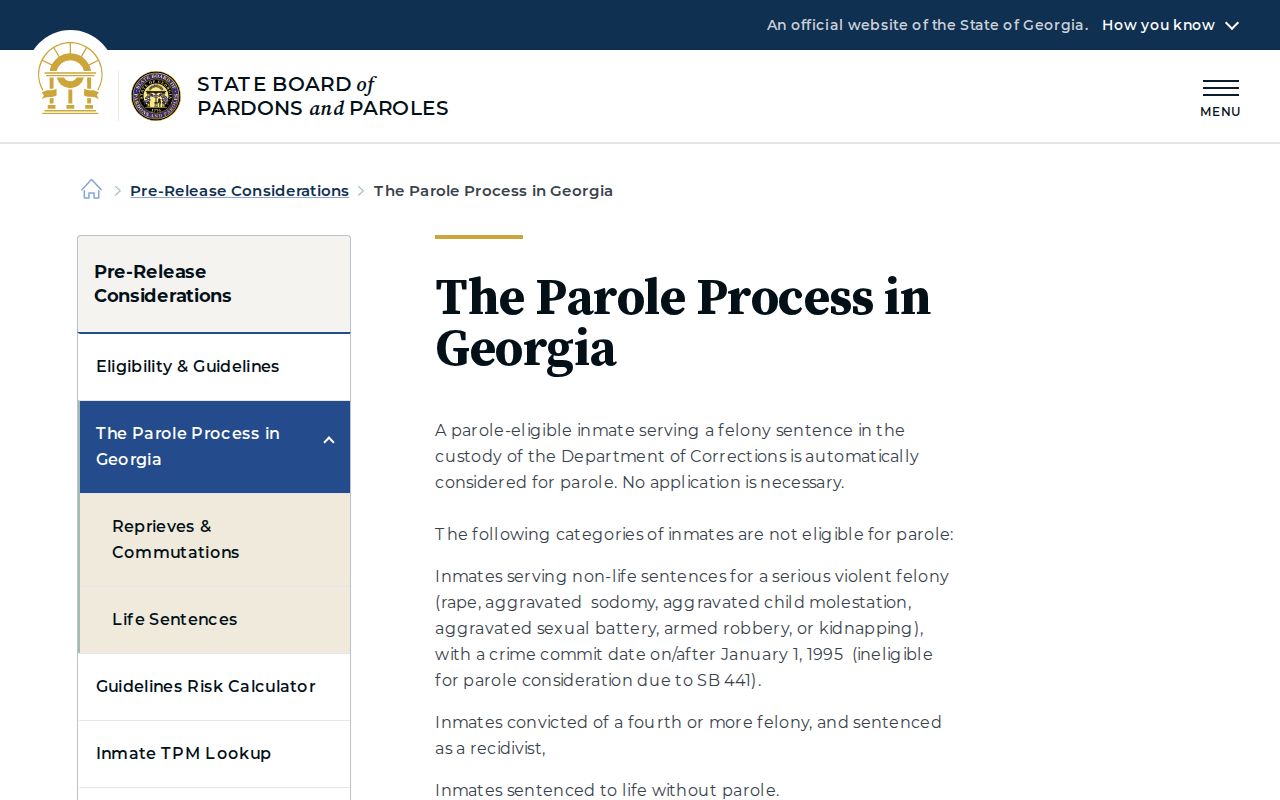
It helps distinguish a consideration stage from a final release date and from supervision after release.
Early County Parole Dates and Eligibility Limits
O.C.G.A. 42-9-45 supplies general parole eligibility rules, including minimum periods for many misdemeanor and felony sentences. Those general rules do not stand alone. Serious violent felony service rules under O.C.G.A. 17-10-6.1, recidivist provisions, life-sentence rules, and other exclusions can alter or bar ordinary parole timing.
A TPM is the planned year and month for final Board review, not a guaranteed day of release. Conduct, required programming, a change in the sentence, or a later Board action may affect it. If an Early County conviction resulted in a GDC transfer, the county jail does not set that state-prison parole date. The Early County court record supplies the sentence, GDC supplies custody and sentence fields, and the Board supplies parole decisions.
Violations, Warrants, and Early County Status Checks
Conditions vary by order and may address reporting, travel, programs, payments, or conduct. A missed report or alleged violation does not by itself show the final outcome. The supervising officer, court, or Board determines the next step under the applicable authority.
A person described as an absconder may have stopped reporting or may be unavailable to supervision, but readers should not infer a warrant from a social post or stale entry. Check the DCS office, the Early County court docket, and the agency that issued any warrant. Georgia VINE can supplement custody-change notice when a matching record is available, though it is not a complete supervision ledger.
When a violation causes arrest, separate the custody record from the supervision record. Early County Jail can confirm local custody and release reason. DCS or the Board can explain the felony supervision status, while the court record shows a probation revocation or modification.
Property and Money After an Early County Release
Early County Jail's detention page gives a useful paper trail for funds. It says each inmate receives a receipt for money held at booking and that the money is placed on the inmate account. Cash or money orders may be left at the front window seven days a week, personal checks are not accepted, and commissary funds must arrive by 1:00 p.m. Tuesday for ordering.
After release to probation or parole, property and account questions remain jail matters rather than DCS or Board matters. The released person or an authorized helper should contact jail release staff or the front window and refer to the receipt. A supervision officer generally cannot resolve a county jail account discrepancy. This distinction keeps the request with the office that created the funds or property record.
How Early County Supervision Ends
Supervision ends through the authority that created or controls it. Parole may end when the term expires or the Board records discharge. Probation may end when the sentence is completed, a court grants early termination, or another lawful discharge applies. A jail release date is not the same date as either event.
First Offender Act treatment adds another distinction. Under O.C.G.A. 42-8-60, qualifying discharge follows completion of the terms or an earlier court release under that statute. Someone may have left jail long before that later court event. For a durable record, obtain the court disposition or discharge and compare it with DCS or Board status. Confirm any unclear end date with the supervising office before treating supervision as closed.