
Early County Jail Releases
The official detention page describes a 74-bed jail operated by the Early County Sheriff. It houses pretrial detainees, people serving local sentences, city inmates, and some state inmates. Those groups leave by different routes. A pretrial detainee may post bond. A local sentence can end through time served. A judge may order release. Another agency may take custody.
The sheriff booking and release record is the lasting local proof. No verified official recent-release feed was found. A name missing from a current roster does not explain the change. Ask for release date, time, reason, and receiving agency. Those fields separate community release from transfer.
| Release reason | Next check |
|---|---|
| Bond or court order | Early County court record |
| Time served | Sheriff record and sentence |
| GDC transfer | GDC offender query |
| Other-agency pickup | Named receiving custodian |
Confirm Early County Releases
Start with the jail for a local arrest. Call 229-723-3150 and give the full name, date of birth if known, booking date, and case number. If staff confirms release, ask whether it was bond, court order, sentence completion, transfer, or another reason.
- Check real-time custody with Early County Jail.
- Request a written record through the sheriff's Open Records page.
- Check the Early County Clerk for bond, sentence, and disposition entries.
- Search Georgia VINE for a custody-change lead.
- If transferred to state prison, use the GDC offender query.
Early County Jail Records
A written request should include the requester's name, phone, return address, specific record, names, dates, times, locations, and available case numbers. Ask for the booking number, charges listed at booking, release date and time, release reason, bond or court notation, and transfer agency. If a portion is exempt, ask for all non-exempt fields.
18610 East South Boulevard
Blakely, GA 39823
Jail: 229-723-3150
Records questions: 229-723-3577
O.C.G.A. 50-18-71 provides the Georgia timing and fee framework. Agencies generally respond within three business days when records are available, or give a description and timeline. Search, retrieval, redaction, and copy charges may apply. The first 15 minutes of employee time are free, and ordinary paper copies may cost 10 cents per page.
Early County Custody Terms
Release from one building is not always discharge from a sentence. A person on bond may still face an active case. A state transfer continues custody. Someone released on parole or probation remains under conditions until formal discharge.
- Bond
- Conditional release while a court case continues.
- Time served
- Completion of the required local jail term.
- Transfer
- Movement to another legal custodian.
- Discharge
- The formal end of a sentence or supervision term.
County court records are the durable source after bond. GDC and the Parole Board govern a state-prison path. The sheriff record remains the source for the local booking and the moment Early County Jail custody ended.
Early County Release Property
The detention page says money held at booking is receipted and placed on the inmate account. Cash or money orders can be left at the front window seven days a week, while personal checks are not accepted. Commissary money must arrive by 1:00 p.m. Tuesday. A receipt can help settle a funds question after release.
Ask release staff what identification or receipt is needed before visiting. The jail handles property and account records. A probation office handles reporting terms. Keeping those roles separate helps a newly released person resolve both issues without missing an instruction.
Historic Early County Jail
An older jail in the Blakely Court Square Historic District is not the active facility. The National Register nomination says the historic jail was designed in 1940 by H. L. Holman Jr. and built by John B. Stokes. It describes brick Art Deco design and a marble entrance.
Current custody and release-record questions go to the South Boulevard jail. The historic building supplies local context only. Using the active address matters for a time-sensitive call, request, or property pickup.
Early County Court Follow-Up
A jail release record proves that one custody stay ended. It does not decide the criminal case. Early County belongs to the Pataula Judicial Circuit, and the county clerk manages Superior, State, and Juvenile court records. A bond order may explain release before trial. A disposition can show a plea, dismissal, sentence, or probation term. A later order may change bond or sentence conditions.
Use the jail and court records together. Match the name, case number, and booking date. Then compare the jail's release reason with the court entry nearest the release. If the jail says transfer, follow the receiving agency. If it says bond, do not treat the case as complete. The circuit's public-observation instructions also say observers should contact the judge's office at least 24 hours before a video proceeding, which can matter when a bond or disposition hearing remains scheduled.
Early County State Transfers
A state sentence changes the record trail. Early County Jail may hold a person until GDC pickup, but its release line then documents transfer rather than final discharge. Search GDC by name, ID, or case number and compare age and other identifiers. A state record may show facility location, charges, and a release date. Parole information may require a separate Board lookup.
After state-prison release, use the Parole Board parolee search and Georgia DCS when supervision applies. Early County is served by DCS Donalsonville. A tentative parole month is not a firm date, and parole is conditional release rather than discharge. Keeping those distinctions clear places the county booking, prison sentence, and community-supervision stages in the right order.
Early County Facility Source
The GDC location directory also lists Early County Jail. Its captured listing helps confirm the operating facility's identity and address.
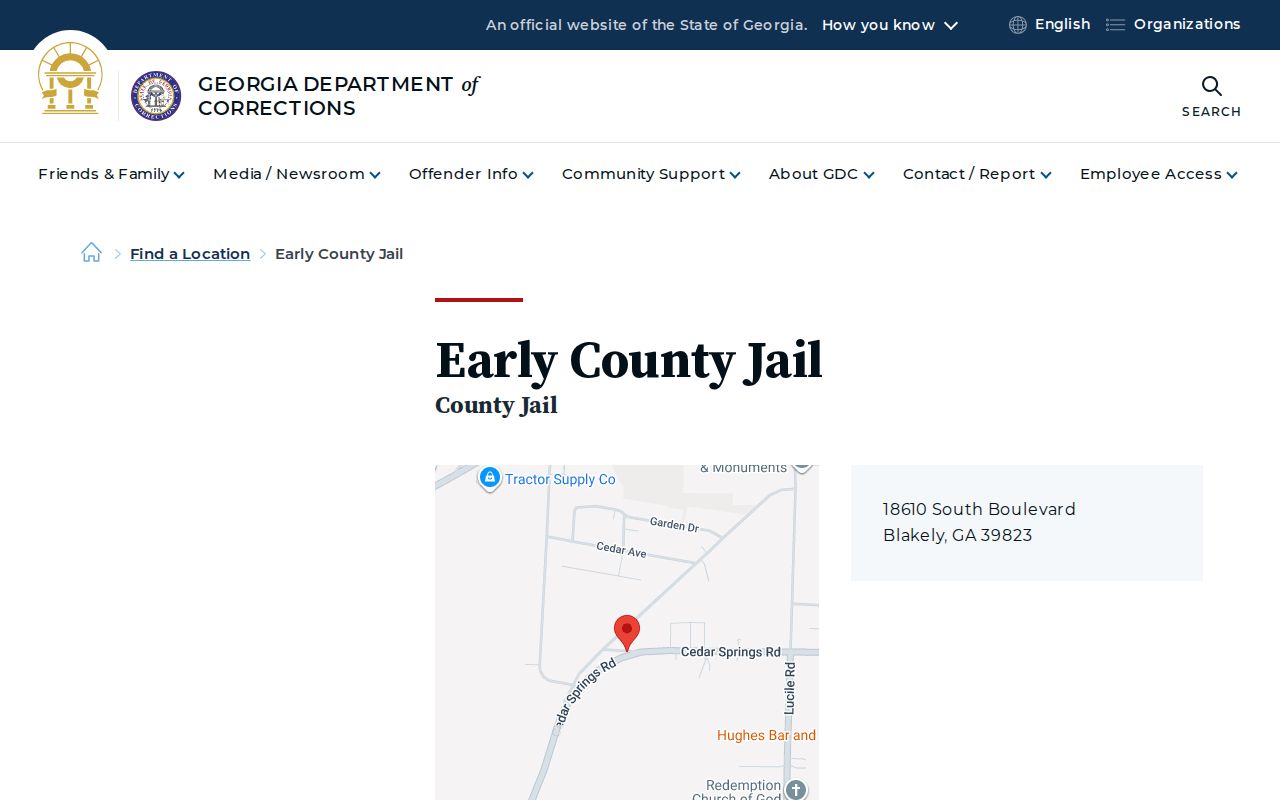
The sheriff, not the statewide directory, remains the custodian for county booking and release records.
Early County Release Record Fields
An Early County release record documents a custody transition, not the whole case. It may prove that jail custody ended without proving that charges ended, all warrants cleared, or supervision expired. The key fields are release date, release time, and release reason. Booking details connect that event to the correct arrest.
| Field | What it shows |
|---|---|
| Name and booking number | The person and local custody event |
| Booking date and agency | When and by whom custody began |
| Charges and case number | The allegations and court-file link |
| Release date and time | When Early County custody ended |
| Release reason | Bond, order, time served, transfer, or another outcome |
| Receiving agency | Where custody continued after transfer |
Request these fields by name. A broad request for all inmate information can be slower and may include exempt material. If the case is pending, evidence and discovery may require a court process even though basic booking and release fields can be requested from the sheriff.
Search Early County Releases
The released-first search path begins with custody type. Early County has no verified public 24-hour or 72-hour release feed, despite the sheriff resource page referring to inmate information. The official detention page is descriptive, while the open-records page supplies the practical copy route. Do not substitute an unofficial directory for the county record.
- Call Early County Jail for a local booking and ask for status plus release reason.
- Submit a sheriff request when a copy or exact release time is needed.
- Check Early County court records for bond, disposition, sentence, or probation orders.
- Use GDC when the jail event was a state transfer or the person served a state sentence.
- Use Georgia VINE for custody alerts, then confirm the alert with the custodian.
- Check Parole Board and DCS records when supervision may follow release.
- Use BOP, USMS, or ICE sources only when facts point to those systems.
Released Last 24 Hours and Released Last 72 Hours explain the recent-release fallback. For a named person, this sequence prevents a roster absence from being mistaken for proof of freedom.
GDC Early County Release Search
The Georgia Department of Corrections offender query is the statewide source when an Early County case led to prison. Search by name, GDC ID, or case number and compare age and other identifiers. GDC says the tool can show charges, facility location, and release date. It is not the right source for most short local jail stays.
| Search field | Use |
|---|---|
| Name | Broad person search |
| GDC ID | Best match for a known state offender |
| Case number | Connects the record to the sentence |
| Age and identity details | Separates similar names |
The official GDC Find an Offender page introduces the state search. Its captured view identifies the statewide source used after an Early County transfer.
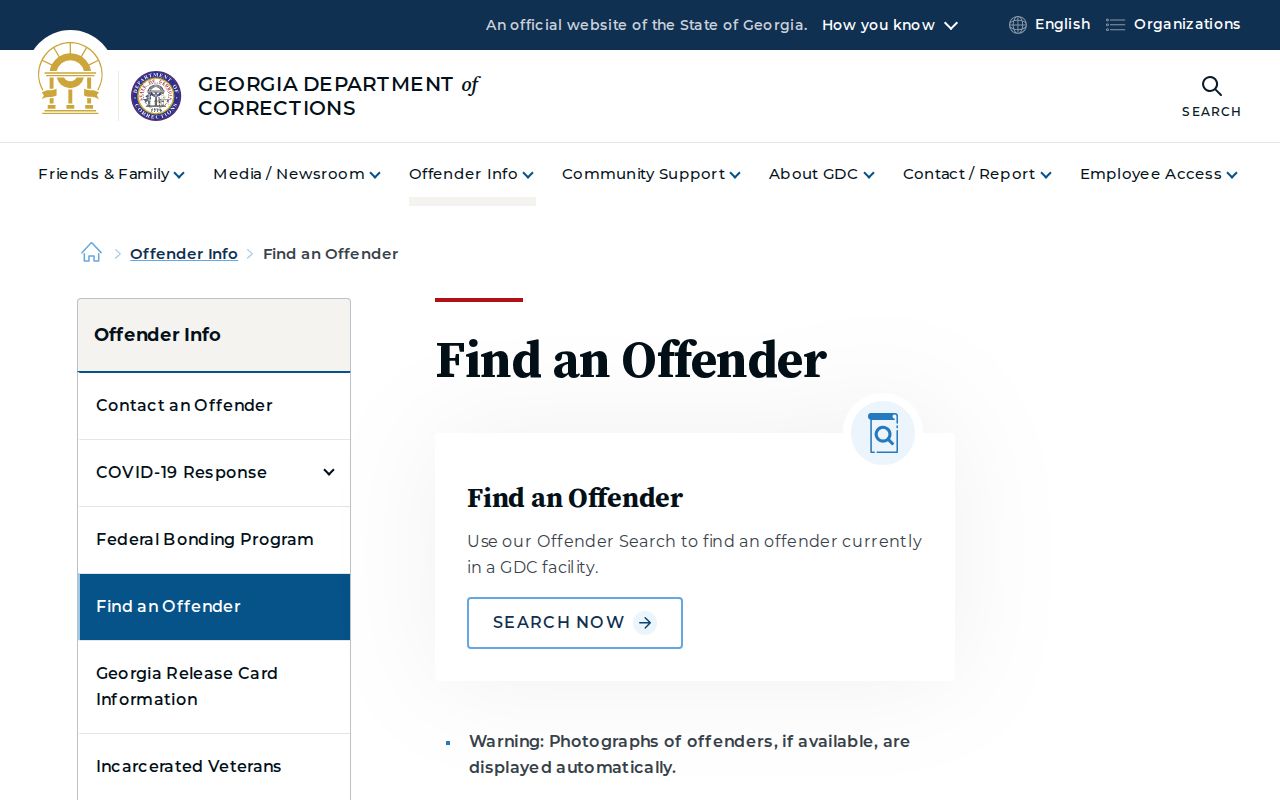
Compare the state result with the county release reason. A transfer-out date and a later state release date describe separate events.
Early County Custody Sources
Each source answers a narrow question. The jail addresses present county custody. A sheriff release record documents the end of the local stay. GDC covers a state sentence, and BOP covers a federal sentence. VINE adds alerts but is not the formal release record.
| Situation | Primary source |
|---|---|
| Still in county jail | Early County Jail |
| Released locally | Sheriff release record |
| Transferred to state prison | GDC offender query |
| On parole or felony probation | Parole Board and DCS |
| Federal sentence | BOP Inmate Locator |
A BOP result marked released or not in BOP custody does not rule out another custody system or supervision. An ICE locator miss also does not prove release. Follow the known custodian and any receiving-agency notation.
Getting Home After Early County Release
Transportation after release is a rural issue in Early County. Southwest Georgia Regional Transit serves 14 counties and accepts reservations at 1-833-799-RIDE. Published service hours are Monday through Friday from 6:00 a.m. to 8:00 p.m. and Saturday from 8:00 a.m. to 4:00 p.m.
Its 2025 one-way fares are $3 in county, $5 for an out-of-county trip under 50 miles, and $10 for a trip over 50 but under 100 miles. Trips can be scheduled up to a week ahead and no later than 2:00 p.m. the prior day. That makes transit useful for a planned pickup, but not a guaranteed same-hour ride after an uncertain jail release.
Early County Record Restriction
Georgia uses record restriction rather than a simple deletion model. The GBI record-restriction source explains that O.C.G.A. 35-3-37 permits restriction of qualifying criminal-history records after prosecutor approval. For arrests after July 1, 2013, the person contacts the prosecutor. Older arrests follow the arresting-agency route.
Restriction is different from jail release. It can change access to qualifying criminal-history material, but it does not rewrite the fact that custody once ended. Georgia.gov says GCIC usually processes complete applications within two to three weeks. Court records, prosecutor approval, and agency records must be checked separately.
A successful First Offender Act discharge is also a court event, not a jail event. The release record answers when custody ended. The discharge order answers whether a qualifying sentence was completed under that law. Keep both records when reconciling a personal custody timeline.
Early County Release Facilities
The full local and fallback map keeps each custody type with its correct source. Early County Jail is the county detention and release-record point. The sheriff probation office is a local reporting office, not a jail. GDC holds state-prison records. BOP and USMS cover federal custody, while ICE covers immigration detention.
- Early County Jail: local booking, release, and transfer record.
- Early County Sheriff's Office Probation Office: local probation reporting.
- Georgia Department of Corrections state prison system: state custody and discharge.
- Federal BOP and USMS channels: federal sentence or pretrial custody.
- ICE detention channel: current immigration custody when applicable.
Choose the source from the release reason, sentence, or receiving-agency entry. That step is more reliable than searching every system without knowing which one had custody.